Starting yoga feels overwhelming — the unfamiliar poses, the Sanskrit names, the intimidating flexibility of everyone on Instagram. But yoga for beginners is not about touching your toes or sitting perfectly still. It’s about building a relationship with your body, one breath at a time. This guide covers everything you need to begin a sustainable practice: which style to choose, which poses to learn first, how often to train, and what common mistakes will hold you back.
Who This Guide Is For
- Best for: complete beginners building their first 30-90 days of practice.
- Not for: readers looking mainly for research synthesis or philosophy-first study. Use the science-backed benefits page or core yoga philosophy guide.
- Go next: once your first month is stable, deepen with the complete yoga poses guide and types of yoga.
What Is Yoga for Beginners?
Yoga for beginners refers to introductory practices designed for people with little or no prior experience — structured around basic positions, simple breathwork, and accessible sequencing that builds body awareness before flexibility or strength.
Yoga is not a single thing. There are dozens of styles, lineages, and traditions. What unites beginners yoga across all of them is the same foundation: alignment-based postures, coordinated breathing, and gradual progression. For the deeper philosophy, history, and meaning behind the practice, see our complete guide to yoga philosophy.
Maya Recommends
- Practice 20-30 minutes, 3 times per week, for your first month.
- Master 5-10 foundation poses before adding advanced transitions.
- Track consistency for 30 days (sessions, energy, sleep) so progress stays objective.
How Should a Complete Beginner Start Yoga?
Start with a slow, beginner-appropriate style, learn a small set of foundation poses, and practice briefly but consistently. For most people, 20-30 minutes three times per week is a safer and more sustainable starting point than long, intense classes.
The biggest mistake beginners make is skipping the fundamentals. Walking into a Vinyasa flow class on day one without understanding how to align your spine, load your joints safely, or breathe through effort is a recipe for frustration — or injury. Here’s how to actually start.
A simple first-month progression
Most beginners do better with a small, repeatable system than with endless variety. This path keeps the first 30 days clear enough to actually follow.
Choose one style
Pick Hatha, gentle Vinyasa, or Restorative and stay there long enough to learn the rhythm.
Learn 5-10 poses
Build familiarity with the same foundation shapes before chasing more complexity.
Practice 3x weekly
Short repeat sessions beat occasional long sessions when the goal is habit and body awareness.
Review after 30 days
Then decide whether to add longer sessions, more challenge, or a second class style.
Step 1: Choose the Right Style First
Not all yoga is equal in difficulty or approach. For beginners, the most accessible styles are:
| Style | Pace | Focus | Best For |
|---|---|---|---|
| Hatha | Slow | Alignment, holding poses | Complete beginners, older adults |
| Yin | Very slow | Passive stretching, connective tissue | Flexibility, stress relief |
| Restorative | Extremely slow | Supported rest, nervous system | Recovery, anxiety, illness |
| Vinyasa | Moderate–fast | Flow between poses | People with some fitness base |
| Ashtanga | Fast, set sequence | Strength, stamina | Athletic beginners |
Start with Hatha if you’ve never practiced before. Avoid Ashtanga or hot yoga in your first month. For a full breakdown of every style, see the complete guide to types of yoga.
Step 2: Learn the Foundation Poses
You don’t need 100 poses. You need 10 done well. These yoga positions for beginners form the backbone of almost every practice:
Standing: Mountain Pose (Tadasana), Warrior I (Virabhadrasana I), Warrior II (Virabhadrasana II), Triangle Pose (Trikonasana)
Floor: Child’s Pose (Balasana), Cat-Cow (Marjaryasana-Bitilasana), Downward-Facing Dog (Adho Mukha Svanasana), Cobra (Bhujangasana)
Supine: Bridge Pose (Setu Bandha Sarvangasana), Reclined Twist (Supta Matsyendrasana)
In our experience working with new practitioners, the most neglected of these is Mountain Pose. Students want to skip ahead to Warrior sequences, but the alignment cues from Tadasana — feet rooted, spine long, shoulders away from ears — are the same in every other standing posture. Spend time there.
Step 3: Learn to Breathe Before You Learn to Stretch
The breath is what separates yoga from stretching. The default technique for beginners is Ujjayi breath — a slightly constricted exhale through the nose creating a soft ocean sound. Inhale through your nose. Exhale through your nose while gently constricting the back of your throat, as if fogging a mirror with your mouth closed. That slight resistance is Ujjayi. Once it feels natural at rest, carry it into movement.
Step 4: Build a Consistent Schedule
Frequency matters more than duration. Three sessions of 20–30 minutes per week beats one 90-minute class per week for building habit and body awareness.
- Day 1: 20–30 min Hatha or guided online practice
- Day 3: Same, or a Yin session for recovery
- Day 5: 30–45 min, include Sun Salutations
After 8–12 weeks, you’ll have enough body vocabulary to attend mixed-level studio classes comfortably.
The 5 Most Important Poses for Beginners — Step-by-Step
1. Child’s Pose (Balasana)
- Kneel on your mat, big toes touching, knees hip-width apart.
- Exhale and fold your torso forward between your thighs.
- Extend arms forward, palms down, or rest them alongside the body.
- Let your forehead rest on the mat. Breathe slowly for 5–10 breaths.
What it does: Releases lower back tension, calms the nervous system, stretches the hips and ankles. Your default resting pose — return to it anytime.
Modification: Folded blanket between thighs and calves if hips don’t reach heels.
⚠️ Contraindication: Avoid with a recent knee injury or in the third trimester of pregnancy.
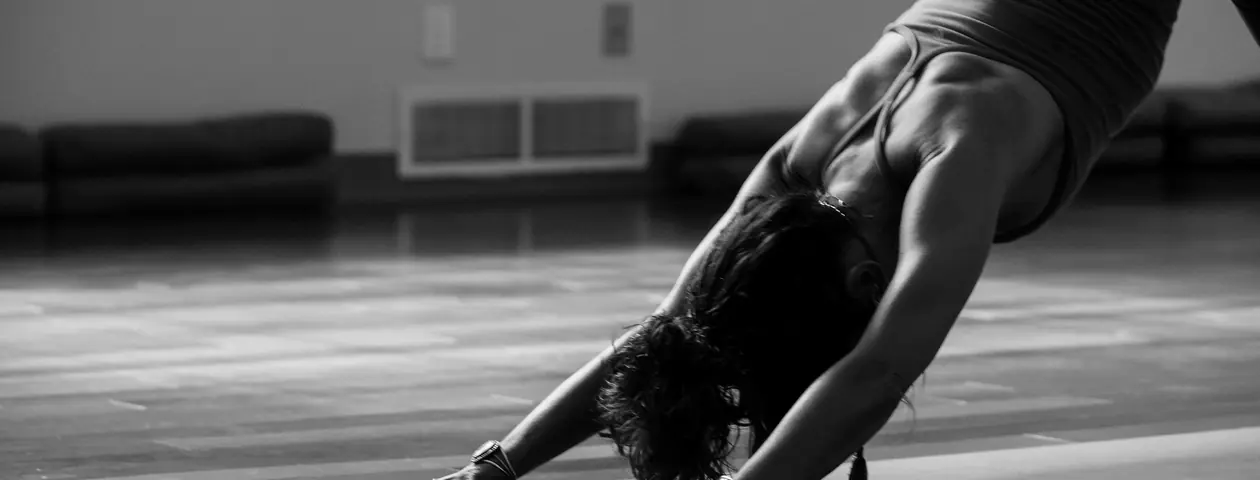
2. Downward-Facing Dog (Adho Mukha Svanasana)
- Begin on all fours, wrists under shoulders, knees under hips.
- Spread your fingers wide and press your palms flat.
- Tuck your toes and lift your hips up and back, forming an inverted V.
- Bend your knees generously if hamstrings are tight — long spine matters more than straight legs.
- Hold for 5–8 breaths.
What it does: Stretches the entire posterior chain, builds shoulder stability, decompresses the spine.
Most common mistake: Rounding the upper back. Rotate upper arms outward and press through all ten fingers.
Modification: Blocks under hands to reduce wrist load.
3. Warrior II (Virabhadrasana II)
- Step feet wide apart (about 3.5–4 feet).
- Turn front foot out 90°, back foot in 15°.
- Bend front knee until it stacks over the ankle, tracking over the second toe.
- Extend both arms parallel to the floor. Gaze over front fingertips.
- Hold for 5 breaths each side.
What it does: Strengthens quadriceps and glutes, opens hips, develops balance.
⚠️ Contraindication: Reduce stance with hip or knee injuries. Never let the bent knee collapse inward.
4. Cat-Cow (Marjaryasana-Bitilasana)
- Start on all fours, wrists under shoulders, knees under hips.
- Cow (inhale): belly drops, chest and tailbone lift, soft forward gaze.
- Cat (exhale): spine rounds upward, chin and tailbone tuck, navel draws in.
- Flow between the two for 8–10 rounds, one breath per movement.
What it does: Warms up the spine in both directions, coordinates breath with movement, relieves lower back stiffness. This is often the first pose where new students feel breath and body synchronize.
5. Corpse Pose (Savasana)
- Lie flat on your back, legs extended, arms slightly away from your sides, palms up.
- Close your eyes. Let your body settle heavily into the floor.
- Do nothing. Stay for 5–10 minutes.
What it does: Integrates the physical work of the practice and activates the parasympathetic nervous system. B.K.S. Iyengar called it the most difficult pose in yoga because it requires full conscious surrender. Never skip it.
What Kind of Yoga Should a Beginner Do?
| Your Situation | Recommended Style | Avoid |
|---|---|---|
| No fitness background | Hatha, Yin | Ashtanga, Power Yoga, Hot Yoga |
| Fit but inflexible | Yin, Hatha | Jumping into advanced Vinyasa |
| Stressed or anxious | Yin, Restorative | Fast-paced, competitive classes |
| Athletic, wants a challenge | Vinyasa, Ashtanga | Starting with advanced sequences |
| Recovering from injury | Restorative, chair yoga | Weight-bearing poses without clearance |
| Over 60 | Gentle Hatha, chair yoga | Hot yoga, fast flows |
The most useful yoga style for a beginner is the one you’ll actually return to. Consistency matters more than intensity.
Can Yoga Help With Mobility?
Yes — and the research supports it. A 2016 study in the International Journal of Yoga found that 10 weeks of yoga significantly improved flexibility, balance, and muscle strength in sedentary adults. Yoga improves mobility through passive stretching (prolonged holds increase fascia extensibility) and active range of motion (Warrior sequences train strength through full ranges). Don’t expect dramatic flexibility gains in the first month. What you’ll notice first is reduced stiffness in the lower back, hips, and shoulders.
Can Yoga Help With Anxiety?
There’s solid evidence that it can. A 2017 meta-analysis reviewed 17 randomized controlled trials and found yoga significantly reduced anxiety symptoms. The mechanism involves the vagus nerve: slow, controlled breathing (like Ujjayi) directly activates the parasympathetic nervous system, reducing cortisol and heart rate. Yin and Restorative yoga are most effective for anxiety — their emphasis on stillness and long exhales specifically targets the stress response. If anxiety is your primary reason for starting yoga, tell your instructor so they can guide modifications.
Common Mistakes Beginners Make
Comparing yourself to others in class. The person next to you doing a full split has been practicing for years, or has hypermobile hips, or is doing something their body will pay for later. Your only reference is your own practice.
Forcing flexibility instead of building it. Yanking yourself into a forward fold strains hamstring attachments at the sitting bones. Bend your knees. Use blocks. Let flexibility develop over months, not sessions.
Neglecting the breath. If you’re holding your breath in a pose, you’re beyond your edge. Back off until you can breathe slowly and steadily.
Skipping warm-up and Savasana. Start with Cat-Cow, Child’s Pose, or gentle joint circles. And do not rush Savasana if you want the practice to settle.
Practicing too infrequently. One class per week can help, but progress is usually slower. Two to three sessions per week is a more reliable starting rhythm for most beginners.
Ignoring pain signals. Discomfort from a muscle stretching is normal. Sharp, shooting, or joint pain is not. Stop immediately if you feel pinching in a joint or pain that persists after the pose ends.
Red Flags / Contraindications
Yoga is generally accessible, but beginners should not interpret “beginner-friendly” as “risk-free.”
- Stop the session if: pain feels sharp, joint-based, radiating, or neurologic rather than muscular and temporary.
- Get medical or rehab clearance first if you have:
- Recent joint surgeries (hip, knee, shoulder)
- Severe osteoporosis — spinal flexion poses carry fracture risk
- Uncontrolled high blood pressure — inversions may need modification or avoidance
- Glaucoma — inversions, including Downward Dog, may need to be limited or avoided
- Active herniated disc — forward folds and deep twists need modification
- Use modifications if: you are pregnant, highly deconditioned, hypermobile, or returning after time away. Blocks, chairs, wall support, shorter holds, and slower transitions are the right tools, not a lesser version of practice.
Note on pregnancy: standard beginner yoga is not automatically pregnancy-safe. Seek a certified prenatal instructor, especially in the first trimester or if your pregnancy is medically complex.
Sun Salutation: Your First Complete Sequence
Once you’ve practiced the foundation poses for 2–3 weeks, connect them into a Sun Salutation (Surya Namaskar) — a flowing sequence linking 12 poses with breath, forming the backbone of Hatha and Vinyasa worldwide.
Simplified beginner version:
- Mountain Pose (Tadasana) — Inhale, arms overhead
- Forward Fold (Uttanasana) — Exhale
- Half Lift (Ardha Uttanasana) — Inhale, flat back
- Step back to Plank (Phalakasana) — Exhale
- Lower slowly to floor — Exhale (knees-chest-chin for beginners; full version: Chaturanga Dandasana)
- Cobra (Bhujangasana) — Inhale
- Downward Dog (Adho Mukha Svanasana) — Exhale, hold 3–5 breaths
- Step or jump forward — Inhale
- Half Lift — Inhale
- Forward Fold — Exhale
- Rise to standing — Inhale
- Mountain Pose — Exhale
Start with 2–3 rounds, build to 5–6 over several weeks.
What to Expect in Your First 90 Days
Weeks 1–2: You’ll feel uncoordinated. Poses that look simple will feel strange. The mind will wander in Savasana. This is normal. Focus on showing up, not performing.
Weeks 3–6: Muscle soreness peaks and settles. You’ll begin recognizing poses by name and moving into them with less hesitation. Breath will start to feel more natural during movement.
Weeks 7–12: Measurable changes in mobility begin. Lower back loosens. Hip flexors become less grippy. Mental effects appear off the mat — better stress resilience, improved sleep, a generalized sense of body ownership. This is when most beginners become consistent practitioners.
FAQ
How should a beginner start yoga?
Start with Hatha yoga — either a beginner-level studio class or a structured online program. Learn 8–10 foundation poses, practice 3 times per week for 20–30 minutes, and prioritize breath coordination before flexibility.
What kind of yoga should I do as a beginner?
Hatha yoga is the most beginner-appropriate style. Yin yoga is an excellent complement for flexibility and stress. Avoid Ashtanga, Power Yoga, and hot yoga until you have at least 2–3 months of regular practice. For a full comparison, see our types of yoga guide.
Can yoga help with anxiety?
Yes, it can help some people, especially when practice is consistent and low enough in intensity to support down-regulation rather than overwhelm. Gentle yoga, slower breathing, and restorative formats are usually the easiest place to start.
Research supports it. Consistent practice of 20–30 minutes, three times per week produces measurable reductions in anxiety symptoms within 8 weeks. Yin and Restorative yoga are most effective.
How often should a beginner practice yoga?
Three times per week is the effective minimum. Sessions can be short — 20–30 minutes — but consistency matters more than duration.
Do I need to be flexible to start yoga?
No. Yoga builds flexibility — it doesn’t require it. Every pose has modifications for limited range of motion. Tight hamstrings and stiff hips are exactly the conditions yoga is designed to address.
What’s Next?
Roll out a mat and do Cat-Cow for five minutes. Once your body has its first experience of breath-coordinated movement, the rest builds naturally. Explore our guide to beginner yoga poses for deeper step-by-step instruction on each foundation posture, and the benefits of yoga article for the science behind everything you’ll start to feel. Ready to practice without leaving home? The yoga for beginners at home guide gives you a full structured routine you can run from your living room.
🔗 Internal Linking
| Target Article | Anchor Text | Placement in Article |
|---|---|---|
| Types of Yoga: Complete Guide | types of yoga | Step 1: Choose the Right Style |
| Yoga Philosophy: Core Principles | yoga philosophy | What Is Yoga for Beginners |
| Benefits of Yoga: What Science Says | benefits of yoga | What’s Next |
Read This Next
- Want a full map of class styles before booking? Compare options in types of yoga explained.
- Need precise alignment after your first week? Review the 12 essential yoga poses.
Sources
Source standard for this page: public-health guidance, systematic reviews, breathwork evidence, and professional training standards used to frame safety and progression.
- Cramer, H., et al. · 2015 · Systematic review and meta-analysis · Matters because it summarizes safety patterns and adverse-event reporting across randomized yoga trials.
- National Center for Complementary and Integrative Health (NCCIH) · 2023-2025 · Public health guidance · Matters because it provides broad, conservative framing on yoga use, safety, and evidence.
- Brown, R. P., & Gerbarg, P. L. · 2005 · Clinical breathwork review · Matters because it supports the role of breath regulation in stress and nervous-system outcomes.
- Registered teacher training standards · Current professional framework · Matters because it informs baseline beginner safety and teacher-facing scope.
Medical note: If you are pregnant, post-surgical, or managing pain conditions, begin with a qualified instructor and ask your healthcare professional for clearance before starting.